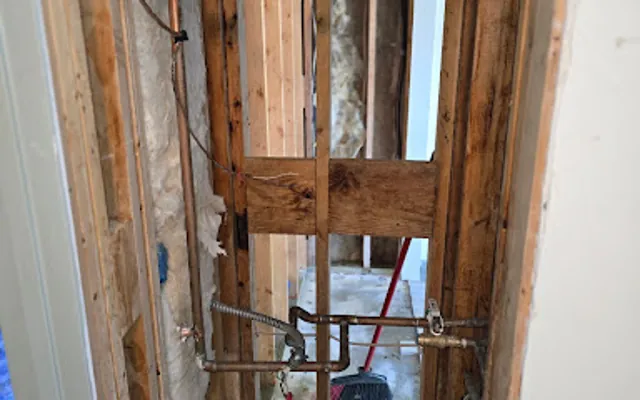
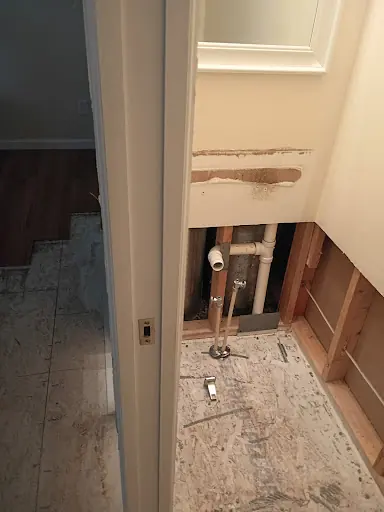
Fort Collins winters bring hard freezes and single-digit cold snaps, and a frozen pipe that splits floods the moment it thaws. Crews clean up the thaw-out and dry every wall and floor the water found.

The crew closes the supply and traces the split, checking exterior walls, crawlspaces, and unheated areas where the freeze usually hits.
Standing water is pulled from floors and carpet, and wet wall or ceiling cavities are opened so the trapped water can drain and dry.
Air movers and dehumidifiers dry framing, insulation, and cavities to a measured target, since water from a freeze often hides in wall voids.
Readings confirm the structure is dry, and the loss is photographed and logged for the insurance claim.

While help is on the way, these first steps, done only where it is safe, limit the damage and protect the insurance claim.
Shut the supply off at the source, or close the home's main valve if the source is not obvious. Stopping the flow limits the damage more than anything else.
Switch off electricity to the affected area, but only if the breaker can be reached without standing in or touching the water.
Get a crew dispatched right away. The sooner extraction and drying begin, the more flooring, drywall, and belongings can be saved.
Take photos and a short video of the water and the affected rooms before anything is moved, so the insurance claim starts strong.
Frozen pipe water damage in Fort Collins typically runs from about $1,000 to $4,500, depending on how long the pipe ran after thawing and how much wall, floor, and insulation were soaked. A pipe caught fast in a crawlspace is on the low end; a line that ran through two levels of a vacant home is on the high end. Sudden freeze bursts are usually covered when the home was reasonably heated, and the loss is documented and billed direct to the carrier.
Crews reach Fort Collins, Larimer County, and the nearby northern Front Range fast, from Old Town, Midtown, and Campus West to Laporte, Wellington, Loveland, Windsor, and Timnath. See the full list on the areas served across Fort Collins page.
See all areas servedEvery loss is photographed, measured, and logged from the first visit, so the paperwork holds up with the insurance carrier.
Technicians follow recognized IICRC drying standards and prove it with daily moisture readings on Fort Collins homes, not guesswork.
Emergency dispatch any hour of the day or night, with a real crew on the way across the Front Range, not a callback in the morning.
A real crew dispatched any hour, not a callback in the morning.
Trained technicians following recognized IICRC drying standards.
Truck-mounted, portable, and submersible for any size loss.
The loss is documented and billed to the carrier directly.
A faucet that runs to a trickle or nothing in cold weather is a warning sign. If a pipe froze and then split, you will often not see the water until it thaws and starts to flow.
Shut off the main water valve immediately so nothing runs when it thaws, then call for cleanup. Do not use open flame to thaw a pipe, and keep power off in any wet area.
Yes. Winters here bring hard freezes and cold snaps near zero, and pipes in exterior walls, crawlspaces, garages, and unheated vacant homes are genuinely at risk each season.
Usually, as long as the home was kept reasonably heated. Damage from leaving the heat off in a vacant home may be denied. The loss is documented to support the claim.
The crew can point out where the freeze occurred and note common fixes like insulating exposed lines, sealing drafts, and keeping heat on in vulnerable areas.
Fort Collins crews are on call 24 hours a day, local and fast, and can be on the way within the hour.
Call (970) 446-5005