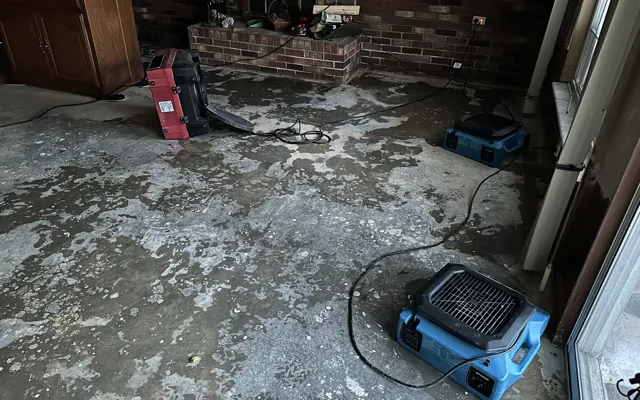
Front Range storms come fast and hit hard, with hail, heavy downpours, and flash flooding off the foothills. When one drives water into a Fort Collins home, crews extract, muck out, and dry it, starting within the hour.

Crews reach the property fast, check for electrical and structural hazards, and tarp or board any storm openings letting more water in.
Standing water is pumped and extracted, and mud, silt, and ruined porous materials are mucked out and hauled away.
Surfaces that touched storm water are cleaned and treated with antimicrobial, since outside floodwater is treated as contaminated.
Air movers and dehumidifiers dry the structure to a verified target, with readings logged for the insurance claim.

While help is on the way, these first steps, done only where it is safe, limit the damage and protect the insurance claim.
Shut the supply off at the source, or close the home's main valve if the source is not obvious. Stopping the flow limits the damage more than anything else.
Switch off electricity to the affected area, but only if the breaker can be reached without standing in or touching the water.
Get a crew dispatched right away. The sooner extraction and drying begin, the more flooring, drywall, and belongings can be saved.
Take photos and a short video of the water and the affected rooms before anything is moved, so the insurance claim starts strong.
Storm and flood cleanup in Fort Collins typically runs from about $2,000 to $8,000, depending on how deep the water got, how much mud and debris came with it, and how much material has to be removed. A contained storm leak is on the low end; several inches of muddy flash-flood water across a lower level is on the high end. Sudden storm damage to the structure is usually covered, though water entering from outside flooding often needs a separate flood policy. Everything is documented for the carrier.
Crews reach Fort Collins, Larimer County, and the nearby northern Front Range fast, from Old Town, Midtown, and Campus West to Laporte, Wellington, Loveland, Windsor, and Timnath. See the full list on the areas served across Fort Collins page.
See all areas servedEvery loss is photographed, measured, and logged from the first visit, so the paperwork holds up with the insurance carrier.
Technicians follow recognized IICRC drying standards and prove it with daily moisture readings on Fort Collins homes, not guesswork.
Emergency dispatch any hour of the day or night, with a real crew on the way across the Front Range, not a callback in the morning.
A real crew dispatched any hour, not a callback in the morning.
Trained technicians following recognized IICRC drying standards.
Truck-mounted, portable, and submersible for any size loss.
The loss is documented and billed to the carrier directly.
Yes. Crews handle both wind-driven rain and roof or window failures and true flash flooding that brings mud and debris inside, with the right pumps and protective gear for each.
Water from outside flooding is treated as category 3, since it can carry mud, sewage, chemicals, and debris. It is removed, the area is disinfected, and porous materials that soaked it up are discarded.
Dispatch runs 24/7 and a Fort Collins crew is usually on site in about an hour. After a widespread storm, calling early gets a crew moving before the schedule fills.
Sudden storm damage to the structure, like a broken window or roof, is usually covered. Water entering from outside flooding typically needs a separate flood policy. The loss is documented to fit whichever coverage applies.
If it is safe, move belongings up out of the water, avoid rooms with sagging ceilings or electrical hazards, and take photos of the damage for the claim.
Fort Collins crews are on call 24 hours a day, local and fast, and can be on the way within the hour.
Call (970) 446-5005